
News
Strengthening Albania’s MAPs Sector: How CNVP’s LED Project Boosts Rural Incomes and Sustainability
Medicinal and Aromatic Plants in Albania are an important source of income for rural households, particularly in mountainous areas of the country. For many households, especially poorer ones in these areas, over 50 percent of their annual income comes from the collection of wild Medicinal and Aromatic Plants, and more recently through the organized cultivation of Medicinal and Aromatic Plants on their own land.
However, rural households face several challenges that hinder their ability to maintain sustainable livelihoods from MAPs. These challenges include low and volatile prices, the depletion of stocks of wild MAPs due to over-harvesting, and significant post-harvest losses resulting from poor drying and storage practices.
To address these challenges, CNVP has been supporting the development of the MAPs sector in Albania for the past five years through its Local Economic Development (LED) project which was launched in 2019 and supported financially by Sweden, aiming to improve the incomes of households involved in the collection and cultivation of Medicinal and Aromatic Plants.
The project implementation is guided by the Market Systems Development approach, with its emphasis on partnering with a range of actors, private businesses, public agencies, and organizations, seeking to bring about changes in their behavior that influence improvements in Medicinal and Aromatic Plant producers’. Access to the information, resources, and technologies they need to increase the income they derive from Medicinal and Aromatic Plant production.
This approach focuses on strengthening the entire MAPs value chain, addressing systemic constraints, and fostering innovations that improve both the range and quality of MAPs produced in Albania.
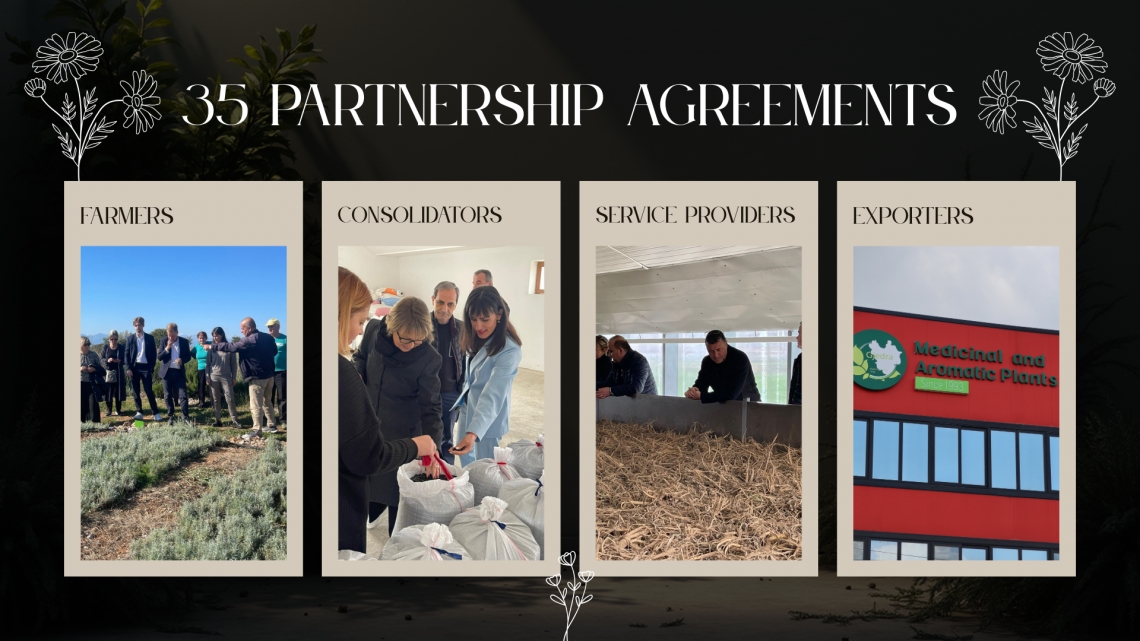
Over 6 years of project implementation, with over 1 million euro direct investment, CNVP entered and implemented partnership agreements with 35 local consolidators, service providers, and exporter companies. As a result, more than 5,500 households gained access to modern drying facilities, certified seedlings, small-scale mechanization, and private extension services, making it possible to increase their families’ incomes by 20–30%.
Beyond these achievements, the LED project has also invested in people by building their capacities, training programs, exchange visits, and educational materials that have strengthened local skills and cooperation within the MAPs value chain. These efforts have promoted innovation, improved product quality, and built stronger networks and links between producers and markets.
Change is possible with the right approach, proper interventions, and willing partners, demonstrated through more resilient business models and increased incomes!
Sweden has made an immense contribution in Albania by promoting and supporting Local Economic Development, social empowerment and equality for the local people in disadvantaged areas.